
Matter vs. Math: The Dark Matter Dilemma
The Cosmic Espresso: Dark Matter, MoND, and the Echoes of a Second Big Bang

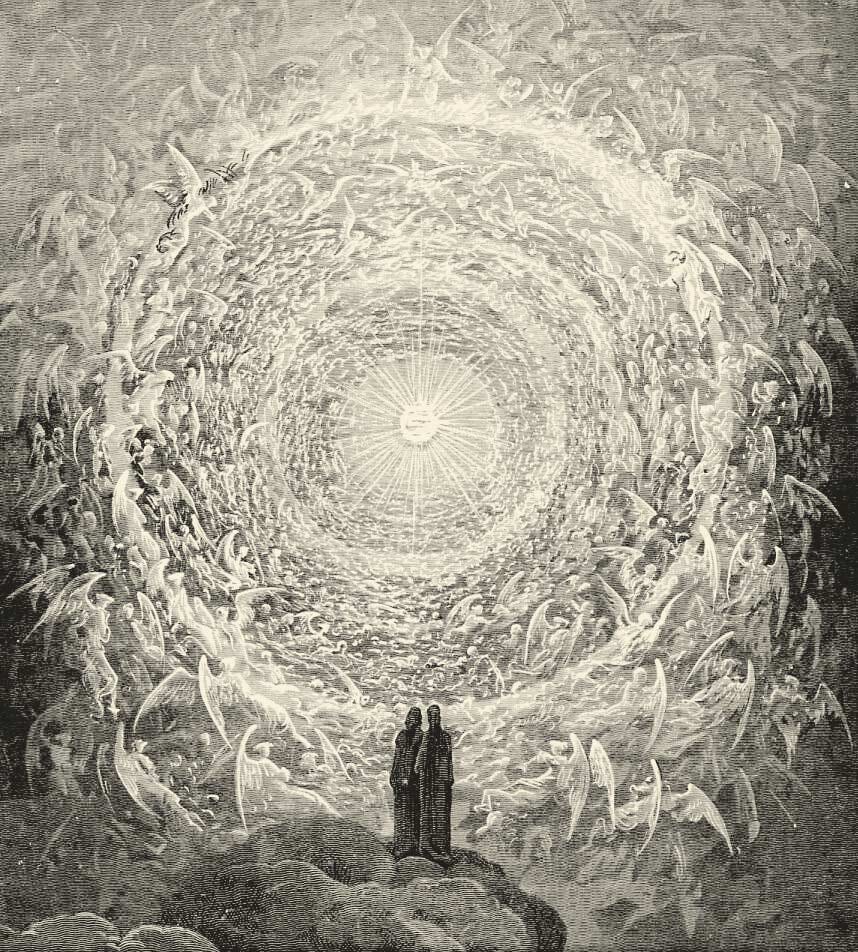
If you think of the universe as a cup of coffee, the liquid itself represents Dark Energy—making up nearly 70% of the brew. The milk we pour in, swirling invisibly yet changing the texture, is Dark Matter. And the tiny pinch of sugar at the bottom? That is us. That is everything we have ever seen, touched, or measured—a mere 5% of the cosmic recipe.
We use the term “dark” not because of its color, but because of our own blindness. We know it’s there only because the “coffee” doesn’t behave the way a simple cup of water should.
The Missing Mass Problem
In the early 20th century, astronomers noticed a glaring inconsistency. When we look at galaxy clusters—massive groups of galaxies held together by gravity—the math simply doesn’t add up. Based on the visible light and matter, these clusters shouldn’t have enough “grip” to stay together. They should be flying apart like loose beads on a string.
To investigate this, scientists turned their gaze toward our neighbor, the Andromeda Galaxy. As a spiral galaxy, it serves as a perfect laboratory for induction; what we learn here likely applies to the entire universe.
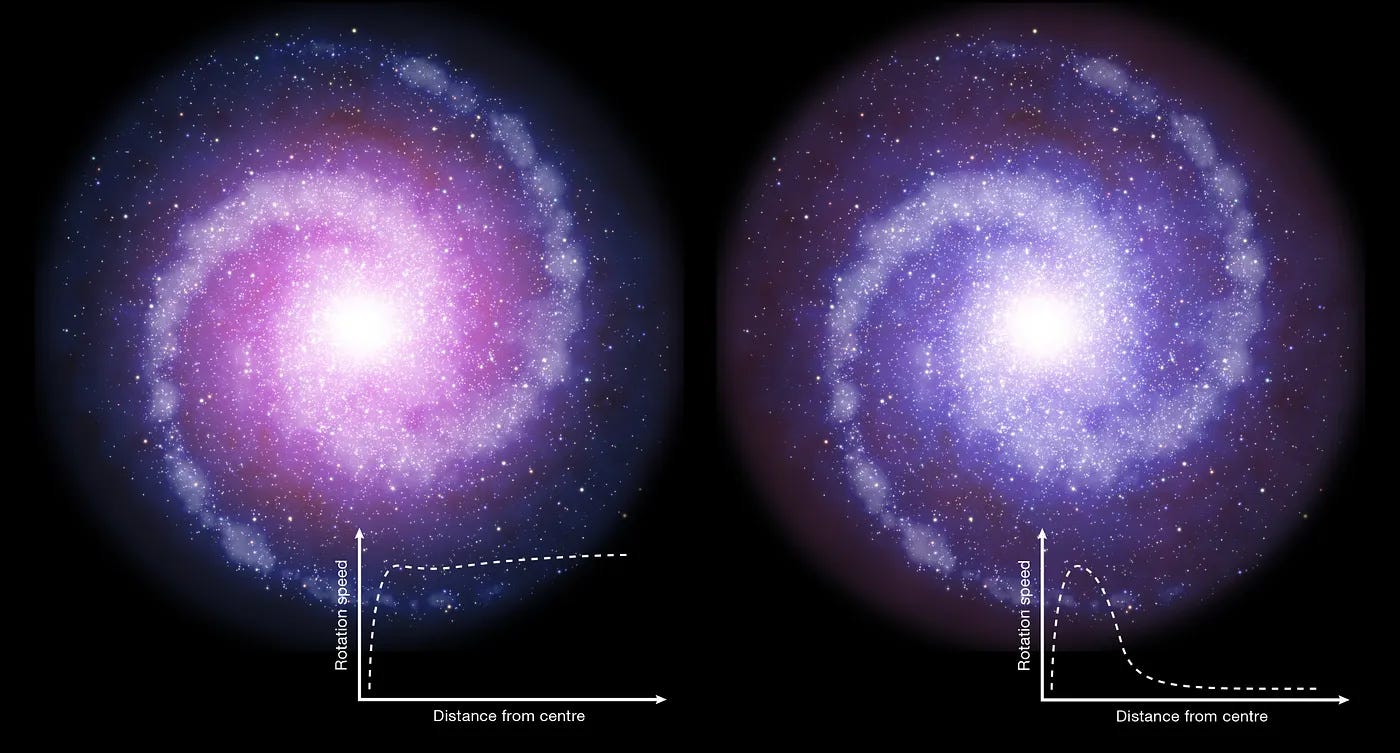
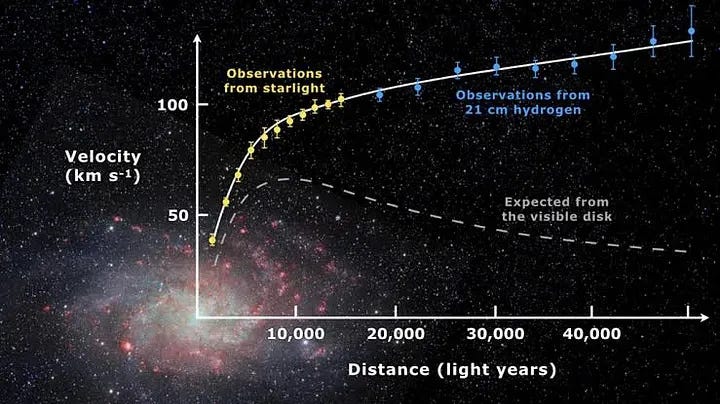
The results were startling. According to Newtonian physics, stars at the outer edges of a galaxy should rotate slower than those near the center, much like the outer planets in our solar system move slower than Mercury. Instead, observations showed that outer stars move just as fast as the inner ones. It was as if an invisible “halo” of mass was providing extra gravitational muscle, allowing these stars to defy the known laws of physics.
The Great Cosmological Duel: ΛCDM vs. MoND
For decades, the scientific community has been split between two primary ways to fix this “broken” math:
ΛCDM (The Standard Model): This model treats Dark Matter as a literal, though invisible, particle (Cold Dark Matter). It also includes Einstein’s “Cosmological Constant” (Λ) to account for Dark Energy. While it is the prevailing theory, it requires us to accept the existence of particles—like WIMPs (Weakly Interacting Massive Particles) or axions—that we have never actually detected. It’s a bit like adding “imaginary milk” to our coffee just to explain why the cup feels heavier.

This model can easily explain inconsistencies in the expected and observed curve of galactic rotation as well as inconsistencies in the rotation speed of objects in the galaxy as they move away from the center of the galaxy, but it explains this illusion by adding dark energy and dark matter to the model. Credit: ESO MoND (Modified Newtonian Dynamics): First proposed by Mordehai Milgrom in 1983, MoND suggests that we don’t need invisible particles. Instead, maybe our understanding of gravity is wrong. MoND proposes that at very low accelerations—like those experienced by stars at the edge of a galaxy—gravity behaves differently than it does on Earth. It’s a “realistic” alternative that fixes the rotation curves without inventing new matter.
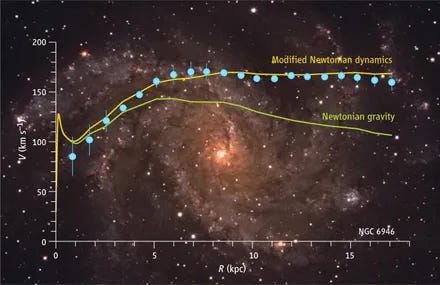
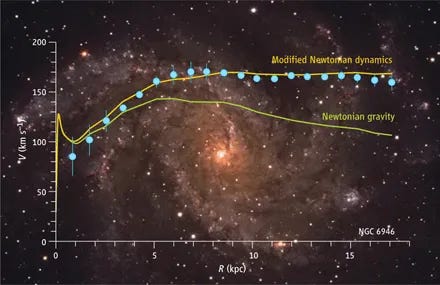
MOND proposes to alter the acceleration of gravity depending on how strong the acceleration is. For large accelerations, which apply to anything within the solar system, the theory is the same as Newton’s, which means that the force on an object is proportional to its acceleration, F = ma. For very tiny accelerations, however, the force is proportional to more like the square of the acceleration. What this means is that for objects that are very distant from a galactic center, the force on them is independent of the distance, and thus their rotational curve is smooth.
A Mind-Bending Twist: The Dark Big Bang
While the ΛCDM and MoND camps were busy debating, a radical new theory emerged from physicists Katherine Freese and Martin Winkler. They propose that we might be looking at the wrong event.1
Traditionally, we assume all matter—visible and dark—was created in the same Big Bang. Freese and Winkler suggest a “Dark Big Bang” occurred roughly a month after the first one.
In this scenario, while the Hot Big Bang gave birth to the photons, quarks, and electrons that make up our “sugar,” a second phase transition in the dark sector sparked a separate explosion, flooding the universe with dark matter.
Can We Prove It?
What makes the Dark Big Bang theory so compelling is that, unlike many “mirror world” or “string theory” hypotheses, it is provable.
Such a massive event would have sent ripples through the fabric of spacetime. We can look for these “exciting experimental signatures” using Pulsars—the universe’s natural lighthouses. By monitoring the timing of these dead stars through projects like the International Pulsar Timing Array (IPTA), we might actually detect the gravitational echoes of this second explosion.
The Overinflated Balloon
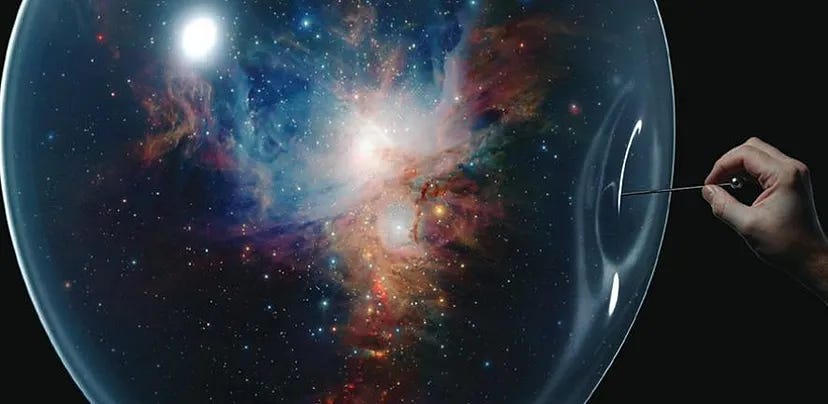
Think of the universe as a nested system of events. The first ‘inflation’ wasn’t actually the Big Bang itself, but a rapid stretching of the fabric of space-time—the Cosmic Inflation. The Hot Big Bang followed, filling that newly stretched void with the matter and radiation we see today.
But then, according to this new theory, a second balloon inside began to inflate: the Dark Big Bang.
Did this second, hidden explosion act as the true trigger for the accelerated expansion we observe today? If so, Dark Energy might not be a separate, mysterious force, but a lingering aftershock of this nested cosmic history.
In the end, the value of a scientific theory isn’t just in how beautiful its equations are, but in its vulnerability to being proven wrong—or right. We are no longer just staring at a cup of coffee and guessing the ingredients. We are finally looking for the steam rising from the brew, hoping it will reveal the secrets of the kitchen where it all began.
Katherine Freese, Martin Wolfgang Winkler. Dark Matter and Gravity Waves from a Dark Big Bang. 22 Feb 2023. Cornell University. arXiv:2302.11579 [astro-ph.CO]. DOI: 10.48550/arXiv.2302.11579.
....Did this second, hidden explosion act as the true trigger for the accelerated expansion we observe today? If so, Dark Energy might not be a separate, mysterious force, but a lingering aftershock of this nested cosmic history.... GRATITUDE ❣️....
I’m not sure why there is so much resistance to the idea that there can be a type of particle (field) that interacts only with gravity. The well known particles have a wide variety of interactions, from quarks that interact with pretty much everything to neutrinos that interact only via the weak nuclear force. What’s so off putting about a dark matter particle that has just one fewer interaction than neutrinos?